

Introduction
Artificial Intelligence is evolving at an extraordinary pace, transforming industries, reshaping careers, and changing the way businesses operate. What began with simple chatbots and text generators has rapidly expanded into intelligent systems capable of reasoning, planning, coding, analyzing images, and even controlling physical machines.
One of the clearest indicators of this transformation is the unprecedented adoption of Generative AI. Within just three years of ChatGPT's launch, Generative AI reached more than half of the world's population faster than the internet, smartphones, or personal computers ever did. This rapid adoption highlights why understanding the top AI trends in 2026 is no longer optional for developers, students, business leaders, or technology enthusiasts.
Artificial Intelligence is no longer viewed as an experimental technology. Instead, it has become part of the digital infrastructure that powers modern software, business operations, cybersecurity, healthcare, manufacturing, and scientific research.
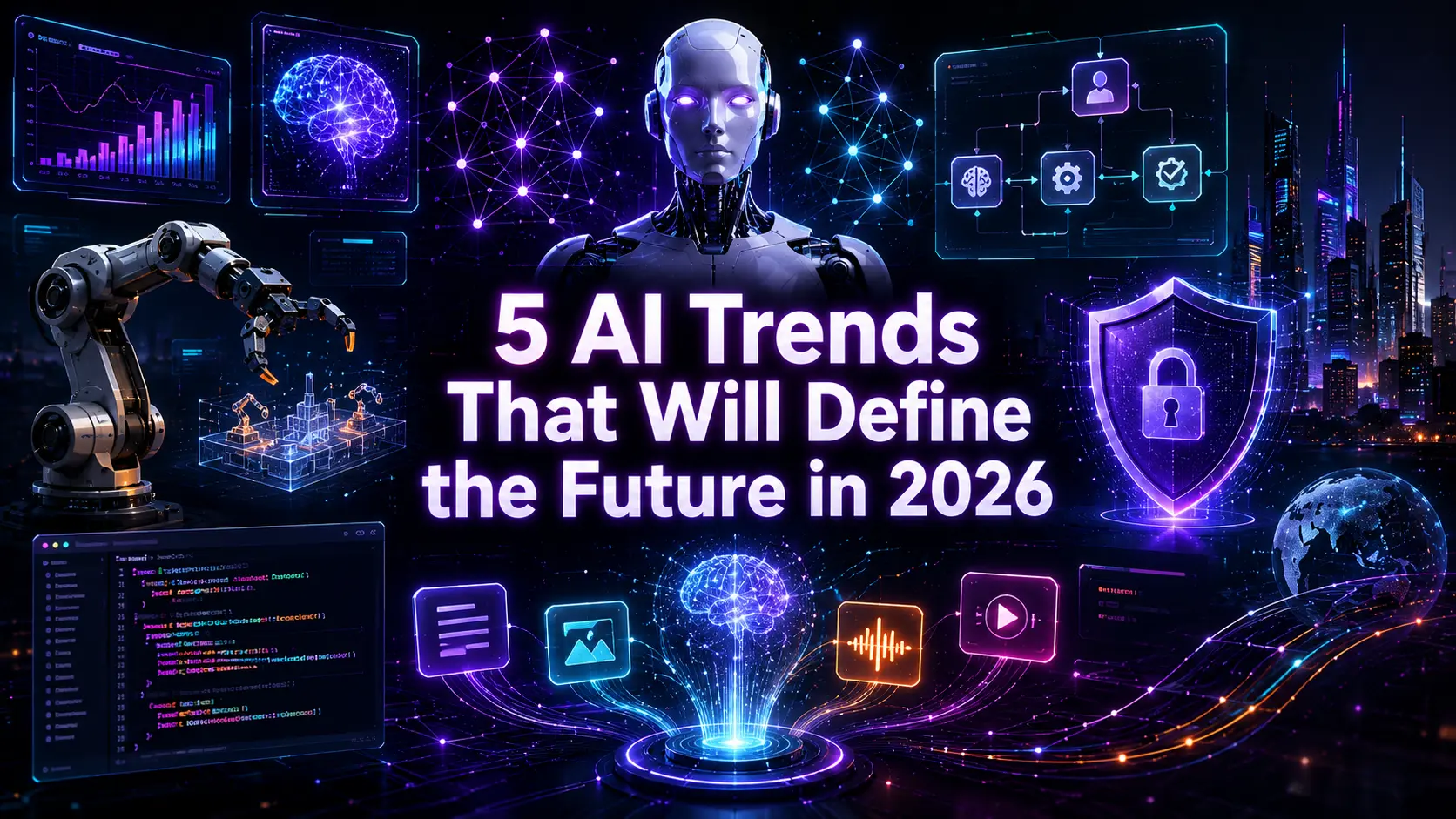
In this article, we'll explore the five biggest AI trends shaping technology in 2026, examine how they're transforming different industries, discuss the skills professionals should learn, and look ahead at where Artificial Intelligence is heading next.
Top AI Trends 2026: The Big Picture
Artificial Intelligence entered a new phase in 2026. Instead of simply generating text or images, modern AI systems are now capable of completing multi-step tasks, understanding different types of media, writing production-ready code, defending against cyber threats, and even controlling physical robots.
Two major developments have accelerated this shift. First, AI models have become significantly better at reasoning, planning, and using external tools. Second, the cost of deploying these models has fallen, making AI practical for businesses of every size.
As a result, Artificial Intelligence is no longer limited to research labs or technology companies. It is becoming an essential part of healthcare, finance, education, manufacturing, software engineering, and countless other industries.
Industry reports also highlight this momentum. Global investment in Artificial Intelligence reached record levels during 2025, while the majority of large organizations now use Generative AI in at least one core business function. These trends indicate that AI is rapidly becoming standard business infrastructure rather than an optional innovation.
Trend #1: Agentic AI
What Is Agentic AI?
Agentic AI represents one of the biggest shifts in modern Artificial Intelligence. Unlike traditional AI systems that respond to a single prompt, agentic AI can plan multiple steps, use external tools, evaluate its own progress, and continue working until a specific objective is completed.
For example, instead of simply generating an email draft, an AI agent can research relevant information, prepare the email, schedule it, create supporting documents, and notify the user once every task has been completed.
This ability to perform autonomous workflows is why many organizations consider Agentic AI the next major evolution after Generative AI.
"The biggest transformation isn't just smarter AI models it's AI systems that can independently plan, execute, and improve complete workflows."
Major enterprise platforms are already integrating AI agents into customer support, sales operations, business analytics, software development, and internal automation. Industry analysts also expect enterprise adoption of AI agents to increase significantly over the next few years as governance and security frameworks continue to mature.
As organizations automate repetitive tasks, professionals who understand AI agent design, workflow automation, Retrieval-Augmented Generation (RAG), and AI governance will be increasingly valuable across multiple industries.

Trend #2: Multimodal AI
What Is Multimodal AI?
Multimodal AI allows a single Artificial Intelligence system to understand and generate multiple types of information including text, images, audio, video, and documents within a single conversation.
Instead of switching between separate tools for writing, image analysis, document review, or voice processing, users can now complete complex tasks using one integrated AI model.
For instance, a developer can upload a screenshot of an application, attach the related source code, describe the issue in natural language, and receive debugging suggestions in one conversation. Similarly, businesses can combine reports, spreadsheets, presentations, and images to generate more comprehensive insights.
Leading AI platforms continue to improve multimodal capabilities, while smaller on-device models are making AI faster, more private, and more efficient by reducing reliance on cloud infrastructure. This trend is expected to make AI assistants significantly more practical for everyday business and personal use.
Trend #3: AI in Cybersecurity
How Artificial Intelligence Is Changing Cybersecurity
Artificial Intelligence is transforming cybersecurity from both sides of the battlefield. While security teams use AI to detect threats faster and automate incident response, cybercriminals are also leveraging AI to launch more convincing and scalable attacks.
Modern AI-powered attacks can generate personalized phishing emails, clone voices, create realistic deepfake videos, and automatically search for software vulnerabilities. These capabilities allow attackers to operate more efficiently than ever before.
"The biggest cybersecurity challenge in 2026 isn't simply smarter attackers it's determining whether what you see or hear can actually be trusted."
To counter these threats, organizations are investing heavily in AI-driven security platforms capable of monitoring network activity, detecting anomalies, identifying suspicious behavior, and responding to incidents in real time.
Security experts also recommend combining Artificial Intelligence with multi-factor authentication, identity verification, employee awareness training, and strong AI governance to reduce the risk of increasingly sophisticated cyber attacks.
Trend #4: AI-Powered Software Development
AI Is Becoming Every Developer's Coding Partner
Artificial Intelligence has dramatically changed how software is built. Modern AI coding assistants now go far beyond simple autocomplete by understanding entire codebases, suggesting architectural improvements, generating documentation, fixing bugs, and refactoring projects automatically.
Tools such as GitHub Copilot, Cursor, Claude Code, Windsurf, and other AI-assisted development platforms are helping developers complete repetitive tasks significantly faster while improving productivity.
Instead of writing every line of code manually, developers increasingly focus on system architecture, problem solving, testing, and reviewing AI-generated code.
Smaller specialized language models are also becoming more common inside development tools. These lightweight models improve speed and reduce operational costs while larger AI models continue handling more complex reasoning tasks.
"Artificial Intelligence is not replacing software developers it is changing how developers spend their time."
Developers who understand Python, prompt engineering, AI-assisted programming, debugging, testing, and software architecture will continue to have a significant advantage as AI becomes a standard part of the development workflow.
Trend #5: Physical AI and Robotics
What Is Physical AI?
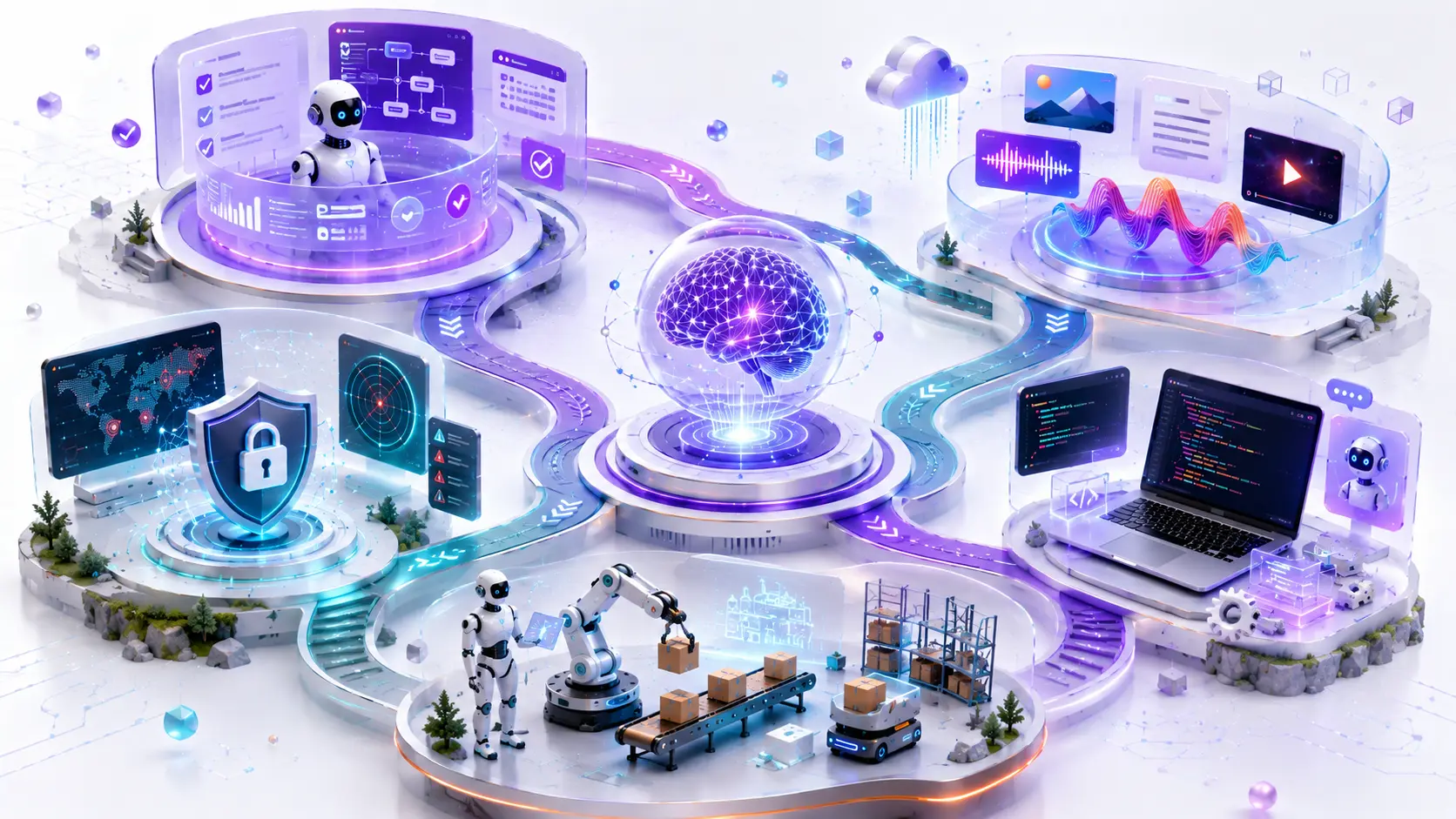
Physical AI combines Artificial Intelligence with robotics, enabling machines to understand their environment, make decisions, and perform physical tasks with minimal human intervention.
Unlike traditional robots that follow fixed instructions, AI-powered robots learn through simulation, computer vision, reinforcement learning, and real-world experience. This allows them to adapt to changing environments instead of repeating predefined actions.
During 2026, Physical AI has moved beyond research laboratories into manufacturing plants, warehouses, logistics centers, healthcare facilities, and industrial automation systems.
Major technology companies are investing heavily in humanoid robots capable of handling repetitive manufacturing tasks, assisting warehouse operations, and supporting industrial productivity. Advances in simulation platforms and AI hardware have significantly reduced development costs while improving robot performance.
"The future of robotics isn't just about building smarter machines it's about creating intelligent systems that can safely collaborate with humans."
Although battery technology, hardware costs, and safety standards continue to present challenges, Physical AI is expected to become one of the fastest-growing areas of Artificial Intelligence over the next decade.
As robotics adoption increases, professionals with expertise in AI, computer vision, edge computing, robotics engineering, and automation systems will be in high demand across manufacturing, healthcare, logistics, and industrial technology.
Industries Being Transformed by AI
Artificial Intelligence is no longer limited to technology companies. Organizations across nearly every industry are using AI to automate repetitive tasks, improve decision-making, reduce operational costs, and deliver better customer experiences.
Healthcare providers use AI to assist with clinical documentation and medical imaging, financial institutions rely on AI for fraud detection and risk analysis, manufacturers deploy AI-powered robots for predictive maintenance, and software companies accelerate development using AI coding assistants.
As AI adoption continues to grow, professionals who understand how to integrate Artificial Intelligence into real business workflows will have a significant competitive advantage.
| Industry | AI Application | Business Impact |
|---|---|---|
| Healthcare | Clinical Documentation & Medical Imaging | Reduced administrative workload and faster diagnosis |
| Finance | Fraud Detection & Risk Analysis | Improved security and faster financial operations |
| Manufacturing | Predictive Maintenance & Robotics | Higher productivity with fewer operational failures |
| Software Development | AI Coding Assistants & Automated Testing | Faster software delivery and improved code quality |
Skills You Should Learn in 2026
Learning how to use Artificial Intelligence is becoming just as important as learning traditional programming. Regardless of whether you're a student, developer, data scientist, or business professional, understanding modern AI technologies will significantly improve your career opportunities.
Instead of trying to learn every AI tool available, focus on building practical skills that employers are actively looking for in production environments.
Recommended Skills
- Python – The most widely used programming language for Artificial Intelligence, Machine Learning, and Data Science.
- Prompt Engineering – Learn how to communicate effectively with Large Language Models to produce reliable results.
- Retrieval-Augmented Generation (RAG) – Understand how AI systems retrieve and use private knowledge bases.
- Vector Databases – Learn technologies that power semantic search and AI applications.
- AI Agent Development – Build autonomous workflows capable of planning and executing complex tasks.
- MLOps – Learn how to deploy, monitor, and maintain machine learning models in production.
These skills consistently appear in job descriptions for AI Engineers, Machine Learning Engineers, Data Scientists, Software Engineers, and AI Product Developers.
Challenges and Ethical Concerns
Despite its remarkable progress, Artificial Intelligence still faces several important challenges. Large AI models can occasionally generate inaccurate information, produce biased outputs, or confidently present incorrect answers. These issues highlight why human oversight remains essential.
Governments around the world are also introducing new AI regulations focused on transparency, accountability, copyright, privacy, and responsible AI development. Organizations are increasingly expected to explain how AI systems make decisions and ensure they operate fairly.
Another frequently discussed concern is workforce transformation. While Artificial Intelligence automates repetitive tasks, it is also creating demand for new technical skills and entirely new job roles. Professionals who continuously learn and adapt will be better positioned to succeed in an AI-driven economy.
"Responsible AI isn't about slowing innovation it's about ensuring that powerful technologies remain transparent, trustworthy, and beneficial for everyone."
The future of Artificial Intelligence depends not only on building smarter models, but also on deploying them responsibly with proper governance, security, fairness, and human oversight.
Future Outlook
Artificial Intelligence is expected to become even more integrated into everyday life over the next few years. Instead of relying on separate AI tools for different tasks, organizations will increasingly adopt intelligent systems capable of reasoning, collaborating, and executing complete workflows with minimal human intervention.
Enterprise AI agents will become more common across customer support, finance, healthcare, software development, manufacturing, and scientific research. Smaller and more efficient AI models will also make on-device intelligence faster, more private, and less dependent on cloud computing.
As governments introduce clearer AI regulations and organizations strengthen governance practices, businesses will place greater emphasis on transparency, security, explainability, and responsible deployment. These changes will help build greater trust while enabling wider adoption across industries.
Rather than replacing human expertise, Artificial Intelligence is expected to become a collaborative technology that enhances productivity, automates repetitive work, and enables professionals to focus on creativity, strategy, and innovation.
Key Takeaways
- Agentic AI is transforming AI from simple assistants into autonomous systems capable of completing complex workflows.
- Multimodal AI enables a single model to understand and generate text, images, audio, video, and documents.
- Artificial Intelligence is becoming a critical component of modern cybersecurity strategies while also introducing new security challenges.
- AI-powered development tools are changing how software engineers write, test, and maintain applications.
- Physical AI and robotics are expanding beyond research labs into manufacturing, logistics, and healthcare.
- Professionals who learn Python, AI agents, Prompt Engineering, RAG, and MLOps will be well positioned for future AI careers.
- Responsible AI development, transparency, and human oversight will remain essential as AI capabilities continue to grow.
Frequently Asked Questions
1. What is the biggest AI trend in 2026?
Agentic AI is widely considered one of the most significant AI trends because it enables intelligent systems to plan, reason, use external tools, and complete multi-step tasks with minimal human intervention.
2. What is Multimodal AI?
Multimodal AI refers to Artificial Intelligence models that can process and generate multiple forms of information including text, images, audio, video, and documents within a single system.
3. Will Artificial Intelligence replace software developers?
Artificial Intelligence is changing software development by automating repetitive tasks and improving productivity, but human developers remain essential for architecture, problem solving, testing, security, and decision-making.
4. Which industries are adopting AI the fastest?
Healthcare, finance, manufacturing, software development, cybersecurity, education, retail, and logistics are among the industries experiencing the fastest adoption of Artificial Intelligence technologies.
5. Which AI skills should beginners learn in 2026?
Beginners should focus on Python, Prompt Engineering, Large Language Models (LLMs), Retrieval-Augmented Generation (RAG), AI agents, vector databases, and MLOps fundamentals.
6. Why is AI governance becoming important?
As Artificial Intelligence becomes more powerful, organizations must ensure that AI systems are transparent, secure, unbiased, explainable, and compliant with evolving regulations.
Conclusion
Artificial Intelligence is entering a new era where intelligent systems are no longer limited to generating content they are increasingly capable of reasoning, planning, automating workflows, and collaborating with humans across almost every industry.
The AI trends shaping 2026 including Agentic AI, Multimodal AI, AI-powered cybersecurity, intelligent software development, and Physical AI are laying the foundation for the next generation of digital transformation. These technologies are creating new opportunities for businesses while redefining the skills professionals need to remain competitive.
Whether you're a student beginning your AI journey, a developer exploring modern tools, or a business leader preparing for the future, understanding these trends today will help you make better decisions tomorrow.
The future belongs to those who combine technical knowledge with continuous learning, responsible innovation, and the ability to work alongside intelligent systems.
Continue Learning with InfoShalaa
Want to stay updated with the latest developments in Artificial Intelligence, Data Science, Programming, Web Development, Cybersecurity, and emerging technologies?
Explore more in-depth tutorials, career guides, industry insights, project ideas, and beginner-friendly learning resources on InfoShalaa. Our mission is to simplify complex technology topics and help learners build practical skills for the future.
Explore MoreContinue reading our latest articles on Artificial Intelligence, Machine Learning, Data Science, Programming, Cybersecurity, and Career Development to stay ahead in the rapidly evolving technology landscape.