


Introduction
Here's an uncomfortable truth about data science hiring in 2026: most resumes are mentally rejected before a recruiter even reaches the certifications section. In today's competitive job market, employers are looking for practical experience rather than a long list of completed courses.
That's where real world data science projects make the difference. A well built project with a live demo, clean GitHub repository, and clear documentation instantly demonstrates your ability to solve business problems using data.
Recruiters have reviewed thousands of resumes filled with identical certifications. What stands out is a candidate who identified a real world problem, built a complete solution from scratch, deployed it successfully, and can confidently explain every decision made during the project.
If you're planning to start a career in Data Science, Machine Learning, or Artificial Intelligence, building the right portfolio projects can significantly improve your chances of getting shortlisted for interviews.
In this guide, we'll explore six recruiter approved data science projects that help you demonstrate practical skills, strengthen your portfolio, and build a resume that stands out in 2026.
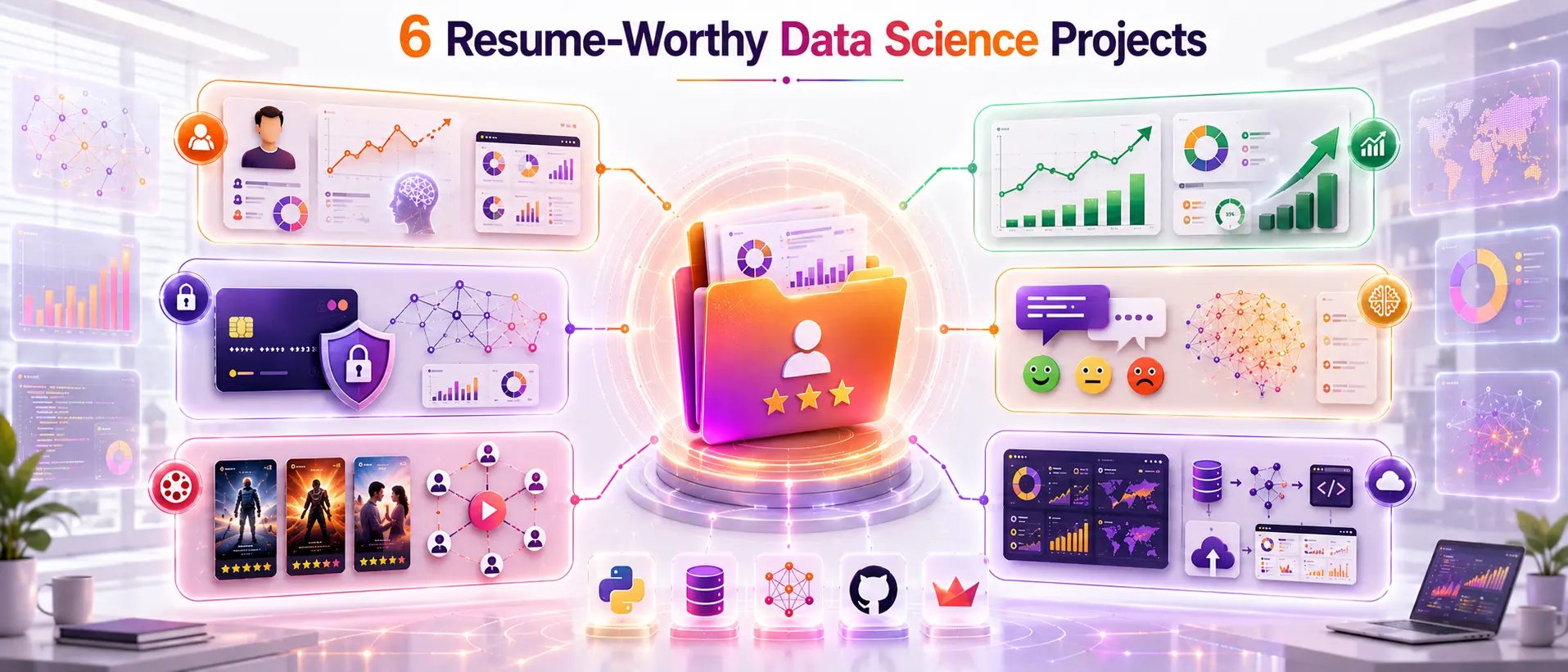
Recruiter InsightRecruiters usually spend only a few seconds scanning a resume before deciding whether to continue reading. The first thing they look for is proof that you can solve a real business problem not just complete an online course. A deployed project with a clean GitHub repository often creates a stronger impression than multiple certificates.
Why Projects Beat Certifications
Artificial Intelligence coding assistants such as GitHub Copilot, Claude, and ChatGPT have made writing code faster than ever before. As a result, recruiters no longer judge candidates solely on whether they can write machine learning code.
Instead, hiring managers want to understand how you think. They want to see whether you can define a problem, collect and clean data, engineer meaningful features, choose an appropriate model, evaluate the results, and communicate your findings in a way that business stakeholders can understand.
A certificate simply confirms that you've completed a course. A project demonstrates that you can apply your knowledge to solve a practical problem using real data.
A strong data science project also showcases several industry-ready skills, including:
- Data cleaning and preprocessing
- Exploratory Data Analysis (EDA)
- Feature engineering
- Machine learning model development
- Model evaluation and performance analysis
- Data visualization and dashboard creation
- Project deployment using tools like Streamlit
- Technical documentation and GitHub best practices
These are the skills that employers expect from entry-level Data Scientists, Machine Learning Engineers, and Data Analysts.
What Makes a Data Science Project Stand Out?
Not every project adds equal value to your resume. Recruiters are far more interested in projects that solve genuine business problems than projects copied directly from online tutorials.
An impressive project should answer four important questions:
| Question | What Recruiters Expect |
|---|---|
| What problem are you solving? | A clearly defined business problem with real-world relevance. |
| Why did you choose this approach? | A logical explanation of algorithms, features, and evaluation metrics. |
| Can someone use your project? | A deployed application or interactive dashboard that demonstrates practical value. |
| Can you explain your results? | Simple insights supported by visuals, metrics, and business recommendations. |
Key TakeawayA recruiter is far more likely to remember a project with a clear business objective, a deployed application, and an easy-to-read GitHub repository than a complex notebook without documentation or deployment.
The Six Projects Every Data Science Student Should Build
The projects below cover the core skills expected in modern data science roles, including machine learning, data visualization, natural language processing, recommendation systems, and end-to-end analytics pipelines.
Whether you're applying for internships, entry-level jobs, or freelance opportunities, these projects will help you demonstrate practical experience while building a portfolio that recruiters actually want to explore.
Let's begin with one of the most beginner-friendly and recruiter-approved machine learning projects Customer Churn Prediction.
1. Customer Churn Prediction
Customer churn prediction is one of the most popular beginner-friendly machine learning projects because it solves a real business problem faced by almost every subscription-based company. Businesses want to know which customers are likely to stop using their service so they can take preventive action before losing revenue.
For this project, you can use a telecom customer churn dataset from Kaggle and build a classification model using Python, Pandas, Scikit-learn, and Streamlit for deployment.
Throughout the project, you'll gain hands-on experience with data preprocessing, feature engineering, model training, evaluation metrics, and deployment all essential skills for aspiring Machine Learning Engineers and Data Scientists.
Instead of filling your GitHub repository with lengthy documentation, focus on presenting your work clearly. Include model performance metrics, a confusion matrix, feature importance, and a few practical business recommendations that explain how a company could reduce customer churn.
Skills You'll Learn
- Classification algorithms
- Feature engineering
- Exploratory Data Analysis (EDA)
- Model evaluation
- Machine learning deployment using Streamlit

2. Sales Forecasting Dashboard
Sales forecasting is an excellent project for students interested in data analytics, business intelligence, and time-series analysis. Organizations rely on accurate sales predictions to manage inventory, plan marketing campaigns, and improve business decisions.
In this project, you'll work with historical retail sales data, perform trend analysis, identify seasonality, and build interactive dashboards using Power BI, SQL, or Streamlit.
Recruiters appreciate this project because it demonstrates your ability to transform raw business data into meaningful insights that decision-makers can easily understand.
When publishing the project on GitHub, include dashboard screenshots, key performance indicators (KPIs), and a concise business summary so recruiters can quickly understand the project's value without running the code.
Skills You'll Learn
- Time-series analysis
- Data visualization
- Dashboard development
- Business intelligence
- SQL querying
3. Credit Card Fraud Detection
Credit card fraud detection is one of the most valuable intermediate-level machine learning projects because it introduces you to highly imbalanced datasets one of the most common challenges in real-world data science.
Using Kaggle's popular fraud detection dataset, you'll build classification models with Scikit-learn, XGBoost, and techniques such as SMOTE to improve model performance on minority classes.
Unlike many beginner projects, success here isn't measured by overall accuracy. Recruiters expect candidates to explain why metrics such as precision, recall, F1-score, and ROC-AUC are more meaningful for fraud detection problems.
Being able to explain these trade-offs during an interview demonstrates practical machine learning knowledge and helps distinguish your portfolio from tutorial-based projects.
Skills You'll Learn
- Imbalanced data handling
- SMOTE oversampling
- Precision and recall analysis
- Fraud detection techniques
- Advanced model evaluation
Portfolio TipDon't stop after training the model. Add a Streamlit interface, publish your project online, and include the live demo link at the top of your GitHub README. Recruiters are far more likely to explore a working application than download a notebook.
4. Movie Recommendation System
Recommendation systems power many of the digital platforms we use every day, including Netflix, Amazon, Spotify, and YouTube. Building a movie recommendation system demonstrates your ability to personalize user experiences using data-driven techniques, making it one of the most impressive intermediate-level data science projects.
The popular MovieLens dataset is an excellent starting point. Using Python, Pandas, and the Surprise library, you can build collaborative filtering, content-based, or hybrid recommendation models that suggest movies based on user preferences.
To make the project more engaging, deploy it as a Streamlit application where users can search for a movie and instantly receive personalized recommendations. Interactive demos make your portfolio significantly more memorable during the recruitment process.
Skills You'll Learn
- Recommendation systems
- Collaborative filtering
- Content-based filtering
- Similarity algorithms
- Model deployment with Streamlit
5. Sentiment Analysis with Natural Language Processing (NLP)
Text data has become one of the most valuable sources of business insights. Companies analyse customer reviews, product feedback, emails, and social media conversations to understand public opinion and improve their products and services.
A sentiment analysis project allows you to work with real-world text datasets while learning Natural Language Processing (NLP). You can use review datasets from Kaggle along with Python, NLTK, Scikit-learn, and modern transformer models from Hugging Face.
Instead of building only a traditional machine learning model, compare it with a transformer-based approach and explain the advantages and limitations of each. Recruiters appreciate candidates who evaluate multiple solutions rather than relying on a single algorithm.
Skills You'll Learn
- Natural Language Processing (NLP)
- Text preprocessing
- Sentiment classification
- Transformer models
- Model comparison and evaluation
6. End-to-End Analytics Dashboard
If you want one project that demonstrates almost every important data science skill, build an end-to-end analytics dashboard. This project combines data cleaning, feature engineering, machine learning, visualization, and deployment into a single business solution.
Choose a real business dataset and build a complete analytics pipeline using Python, SQL, Plotly, and Streamlit. Include interactive dashboards, business KPIs, predictive insights, and deployment instructions to create a professional portfolio piece.
Unlike notebook-based projects, an end-to-end dashboard shows recruiters that you understand the complete machine learning lifecycle from raw data to a production-ready application.
Skills You'll Learn
- Data pipeline development
- Interactive dashboards
- Business analytics
- Data visualization
- Application deployment
Comparison at a Glance
| Project | Key Skills Demonstrated | Best For |
|---|---|---|
| Customer Churn Prediction | Classification, Feature Engineering, Model Evaluation | Machine Learning Engineer |
| Sales Forecasting Dashboard | Time-Series Analysis, KPI Design, Data Visualization | Data Analyst |
| Credit Card Fraud Detection | Imbalanced Classification, SMOTE, Precision & Recall | Machine Learning Engineer |
| Movie Recommendation System | Recommendation Systems, Collaborative Filtering | Product-Based Companies |
| Sentiment Analysis (NLP) | Text Processing, NLP, Transformer Models | NLP & AI Roles |
| End-to-End Analytics Dashboard | Data Pipeline, Dashboard Development, Deployment | Data Scientist |
Pro TipRecruiters rarely remember the project with the most complex algorithm. They remember the project that solves a real business problem, has a clean GitHub repository, includes a live demo, and clearly explains the business impact.
Building a Portfolio That Actually Gets Read
A strong portfolio is more than a collection of notebooks. Each project should have its own GitHub repository with a clear README that explains the business problem, dataset, methodology, results, deployment process, and key insights.
Whenever possible, deploy your application using platforms such as Streamlit Community Cloud or Render. Include the live demo link at the top of your repository so recruiters can explore your work without downloading or configuring your project locally.
Common Mistakes to Avoid
Even strong technical projects can fail to impress recruiters if they are poorly presented. Many candidates spend weeks building machine learning models but overlook the details that hiring managers notice first.
Avoiding the following mistakes can significantly improve the quality of your portfolio and increase your chances of getting shortlisted for interviews.
- Building only tutorial-based projects without adding your own ideas or improvements.
- Uploading Jupyter notebooks without deploying the final application.
- Choosing random datasets that don't solve a meaningful business problem.
- Reporting only accuracy without explaining important evaluation metrics.
- Ignoring feature engineering and data cleaning in project documentation.
- Writing long GitHub READMEs that are difficult to scan quickly.
- Skipping deployment, making recruiters unable to test your project easily.
Data Science Project Checklist
Before adding any project to your resume, make sure it checks the boxes below.
| Checklist | Status |
|---|---|
| Business problem is clearly defined | ✔ |
| Dataset source is properly mentioned | ✔ |
| Data cleaning and feature engineering are documented | ✔ |
| Evaluation metrics are explained clearly | ✔ |
| GitHub repository has a professional README | ✔ |
| Project includes a deployed live demo | ✔ |
Frequently Asked Questions
How many data science projects should I include on my resume?
Quality matters far more than quantity. Three to five well-documented projects that solve real-world business problems are usually more effective than a long list of incomplete or tutorial-based projects.
Should beginners include simple projects?
Yes. Beginner-friendly projects are perfectly acceptable if you clearly explain your approach, feature engineering decisions, model evaluation, and business insights. Recruiters value understanding more than complexity.
Do recruiters really care about deployment?
Absolutely. A deployed application allows recruiters to interact with your project immediately, making it much more memorable than a static notebook or screenshots alone.
Which project is best for freshers?
Customer Churn Prediction and Sales Forecasting Dashboard are excellent starting points because they introduce core machine learning and analytics concepts while solving practical business problems.
What makes a data science project stand out?
Projects stand out when they solve a real business problem, include clean code, meaningful visualizations, strong documentation, and a deployed application that recruiters can explore easily.
Conclusion
Certificates may help your resume get noticed, but practical projects are what convince recruiters that you're ready for the job. A well-designed portfolio demonstrates your ability to solve business problems, work with real-world datasets, build machine learning models, communicate insights, and deploy complete applications.
Instead of trying to build dozens of projects, focus on completing one high-quality project at a time. Pay attention to documentation, deployment, visualization, and business impact. These are the details that hiring managers remember during the recruitment process.
Whether you're preparing for internships, entry-level data science roles, or machine learning interviews, investing time in practical projects will always deliver greater value than collecting certificates alone.
Final TakeawayDon't build projects just to fill your GitHub profile. Build projects that solve meaningful problems, tell a compelling story, and demonstrate the skills employers are actively looking for in 2026.
Continue Learning with InfoShalaa
Looking for more practical Data Science, Machine Learning, Artificial Intelligence, Programming, and Career guides?
Explore more tutorials and project-based learning resources on InfoShalaa to build industry-ready skills, strengthen your portfolio, and stay updated with the latest technology trends.
Keep learning, keep building, and let your projects speak louder than your certificates.