


The technology industry is evolving faster than ever, and salaries are rising alongside demand for professionals who can build, deploy, and manage modern digital systems. Artificial Intelligence, cloud computing, cybersecurity, and data engineering are no longer niche specialties they have become the foundation of digital transformation across nearly every industry.
Whether you're a student planning your first career, a software developer looking to specialize, or an IT professional considering a career switch, understanding which technology roles offer the strongest combination of salary, demand, and long-term growth is more important than ever.
However, choosing a career based solely on salary can be misleading. The highest-paying jobs often require a combination of strong technical fundamentals, practical project experience, cloud knowledge, problem-solving skills, and continuous learning. The good news is that many of these careers are more accessible than ever for motivated learners willing to build real-world skills.
In this guide, we'll explore the 10 highest-paying tech jobs in 2026, including their average salaries, required skills, career roadmaps, certifications, and the type of professionals each role is best suited for.

Why Are Tech Salaries Increasing in 2026?
Technology companies are no longer hiring only programmers they're looking for professionals who can solve complex business problems using AI, cloud infrastructure, automation, and secure software systems. As organizations move beyond experimentation and deploy AI into production, demand for highly skilled engineers continues to increase.
Research from leading industry organizations shows that companies increasingly value professionals who combine software engineering with AI, cloud platforms, cybersecurity, and data expertise. Rather than replacing technical jobs, AI is raising the value of specialized skills that help businesses deploy reliable, secure, and scalable systems.
This shift means the highest salaries are no longer reserved for managers alone. Skilled engineers, architects, AI specialists, and cybersecurity professionals can often earn compensation comparable to senior leadership roles.
Top 10 Highest-Paying Tech Jobs in 2026
| Career | Primary Skills | Best For |
|---|---|---|
| AI Engineer | LLMs, Python, APIs, Deployment | AI Product Development |
| Machine Learning Engineer | ML, PyTorch, MLOps | Production AI Systems |
| AI Research Engineer | Deep Learning, Mathematics | Advanced AI Research |
| Cloud Solutions Architect | AWS, Azure, Kubernetes | Enterprise Cloud |
| Cybersecurity Engineer | Cloud Security, IAM, SIEM | Security & Compliance |
| Data Scientist | Python, SQL, Statistics | Business Analytics |
| DevOps Engineer | CI/CD, Docker, Kubernetes | Platform Engineering |
| Full Stack Engineer | Frontend, Backend, APIs | Software Development |
| Blockchain Developer | Solidity, Smart Contracts | Web3 & FinTech |
| AI Automation Engineer | Prompting, APIs, Workflows | Enterprise AI Automation |
1. AI Engineer
AI Engineers have become one of the most sought-after professionals in 2026. Their primary responsibility is transforming machine learning models and large language models into reliable, production-ready applications that businesses can actually use.
Unlike traditional machine learning specialists who mainly focus on model development, AI Engineers bridge the gap between software engineering, cloud infrastructure, APIs, model deployment, monitoring, and responsible AI practices.
Modern AI Engineers typically work with LLM APIs, vector databases, retrieval-augmented generation (RAG), AI agents, cloud platforms, Docker, monitoring tools, and secure deployment pipelines.
Key Skills You'll Need
- Python programming
- REST APIs & SDKs
- Large Language Models (LLMs)
- Vector Databases & RAG
- Docker & Cloud Platforms
- Monitoring & AI Evaluation
- SQL & Data Modeling
Career Roadmap
- Learn Python, Git, SQL, and APIs.
- Understand machine learning fundamentals.
- Build AI applications using modern LLM APIs.
- Learn deployment, monitoring, and cloud infrastructure.
- Create production-ready AI portfolio projects.
2. Machine Learning Engineer
Machine Learning Engineers focus on building scalable systems that train, validate, deploy, and monitor predictive and generative AI models. They combine strong software engineering practices with deep machine learning knowledge to create production-ready ML systems.
As organizations deploy increasingly sophisticated AI solutions, ML Engineers play a crucial role in designing data pipelines, automating training workflows, monitoring model performance, and ensuring models remain accurate after deployment.
Skills You'll Learn
- Python & SQL
- PyTorch or TensorFlow
- Feature Engineering
- Model Deployment
- MLOps
- Docker & Kubernetes
- Cloud Machine Learning Platforms
3. AI Research Engineer
AI Research Engineers work on the cutting edge of artificial intelligence by developing new models, reproducing research papers, improving datasets, and experimenting with advanced deep learning architectures.
This role is more research-intensive than traditional software engineering and is ideal for professionals who enjoy mathematics, experimentation, and solving complex AI problems. Many frontier AI companies and research labs seek candidates with strong foundations in linear algebra, probability, optimization, and deep learning frameworks such as PyTorch.
Skills You'll Learn
- Deep Learning
- PyTorch
- Linear Algebra
- Probability & Statistics
- Scientific Research
- Distributed Training
- Experiment Design
4. Cloud Solutions Architect
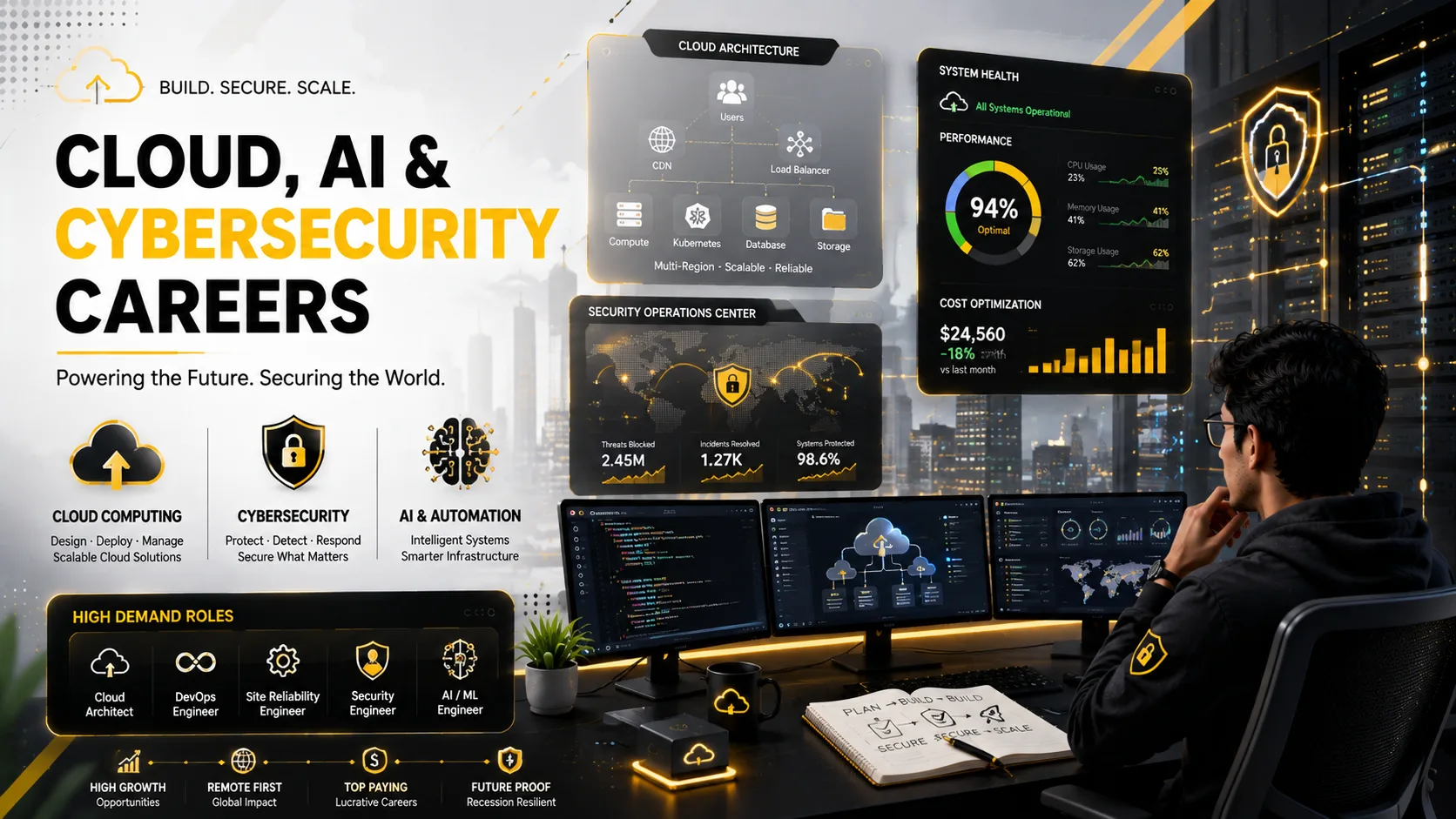
As businesses continue migrating their infrastructure to the cloud, Cloud Solutions Architects have become one of the highest-paid professionals in the technology industry. Their role involves designing secure, scalable, and cost-effective cloud systems that support modern applications and business operations.
Cloud architects work closely with software developers, DevOps engineers, security teams, and business stakeholders to select the right cloud services, optimize infrastructure costs, and ensure high availability. Organizations using Amazon Web Services (AWS), Microsoft Azure, or Google Cloud Platform rely heavily on these professionals to build reliable cloud-native architectures.
Key Skills You'll Need
- AWS, Azure, or Google Cloud Platform
- Docker & Kubernetes
- Networking Fundamentals
- Linux Administration
- Infrastructure as Code (Terraform)
- Cloud Security
- High Availability & Disaster Recovery
Career Roadmap
- Learn Linux and networking fundamentals.
- Master one major cloud platform.
- Understand containers and Kubernetes.
- Study cloud architecture patterns.
- Earn cloud certifications and build real-world projects.
5. Cybersecurity Engineer
Cybersecurity Engineers protect organizations from increasingly sophisticated cyber threats by designing secure systems, monitoring networks, identifying vulnerabilities, and responding to security incidents. With AI-powered cyber attacks becoming more common, demand for skilled security professionals continues to grow rapidly.
Modern cybersecurity extends far beyond installing antivirus software. Engineers now secure cloud environments, identity systems, APIs, enterprise networks, and AI applications while ensuring organizations comply with security standards and industry regulations.
Key Skills You'll Need
- Network Security
- Cloud Security
- Identity & Access Management (IAM)
- SIEM Platforms
- Penetration Testing
- Incident Response
- Security Automation
Recommended Certifications
- CompTIA Security+
- Certified Ethical Hacker (CEH)
- CISSP
- AWS Security Specialty
6. Data Scientist
Data Scientists transform raw business data into meaningful insights that support strategic decision-making. They combine statistics, programming, visualization, and machine learning to solve real-world business problems across industries such as finance, healthcare, e-commerce, manufacturing, and marketing.
In 2026, the role has evolved beyond traditional dashboards. Modern Data Scientists increasingly work with generative AI, predictive analytics, automated machine learning, and AI-assisted analytics platforms to deliver faster and more accurate insights.
Strong business understanding is just as important as technical expertise. Successful Data Scientists communicate findings clearly and help organizations make informed decisions based on data rather than intuition.
Key Skills You'll Need
- Python
- SQL
- Statistics & Probability
- Pandas & NumPy
- Machine Learning
- Power BI or Tableau
- Data Storytelling
Career Roadmap
- Learn Python, SQL, and statistics.
- Master data analysis and visualization.
- Study machine learning fundamentals.
- Build end-to-end data science projects.
- Create a strong GitHub portfolio with deployed dashboards.
Career InsightCloud computing, cybersecurity, and data science continue to offer some of the best long-term career opportunities because organizations across every industry rely on secure infrastructure, scalable cloud platforms, and data-driven decision-making. Professionals who combine technical expertise with practical project experience are often among the highest-paid candidates in the hiring market.
7. DevOps Engineer
DevOps Engineers bridge the gap between software development and IT operations by automating application deployment, infrastructure management, monitoring, and continuous delivery. Instead of manually configuring servers and deployments, DevOps professionals build automated pipelines that enable teams to release software faster and more reliably.
With cloud-native applications becoming the industry standard, DevOps Engineers are responsible for maintaining scalable infrastructure, improving deployment speed, reducing downtime, and ensuring applications remain secure throughout the development lifecycle.
Key Skills You'll Need
- Linux Administration
- Docker & Kubernetes
- CI/CD Pipelines
- Git & GitHub
- Terraform
- AWS, Azure, or Google Cloud
- Monitoring Tools (Prometheus, Grafana)
8. Full Stack Engineer
Full Stack Engineers build complete web applications by working on both the frontend and backend. They develop user interfaces, create APIs, manage databases, implement authentication systems, and deploy applications to cloud platforms.
Companies value Full Stack Engineers because they can contribute across multiple areas of a project, making them highly productive members of small startups as well as large enterprise teams. AI-powered development tools have further increased productivity by automating repetitive coding tasks while allowing engineers to focus on architecture and business logic.
Key Skills You'll Need
- HTML, CSS & JavaScript
- React or Next.js
- Node.js & Express
- SQL & NoSQL Databases
- REST APIs
- Git & GitHub
- Cloud Deployment
9. Blockchain Developer
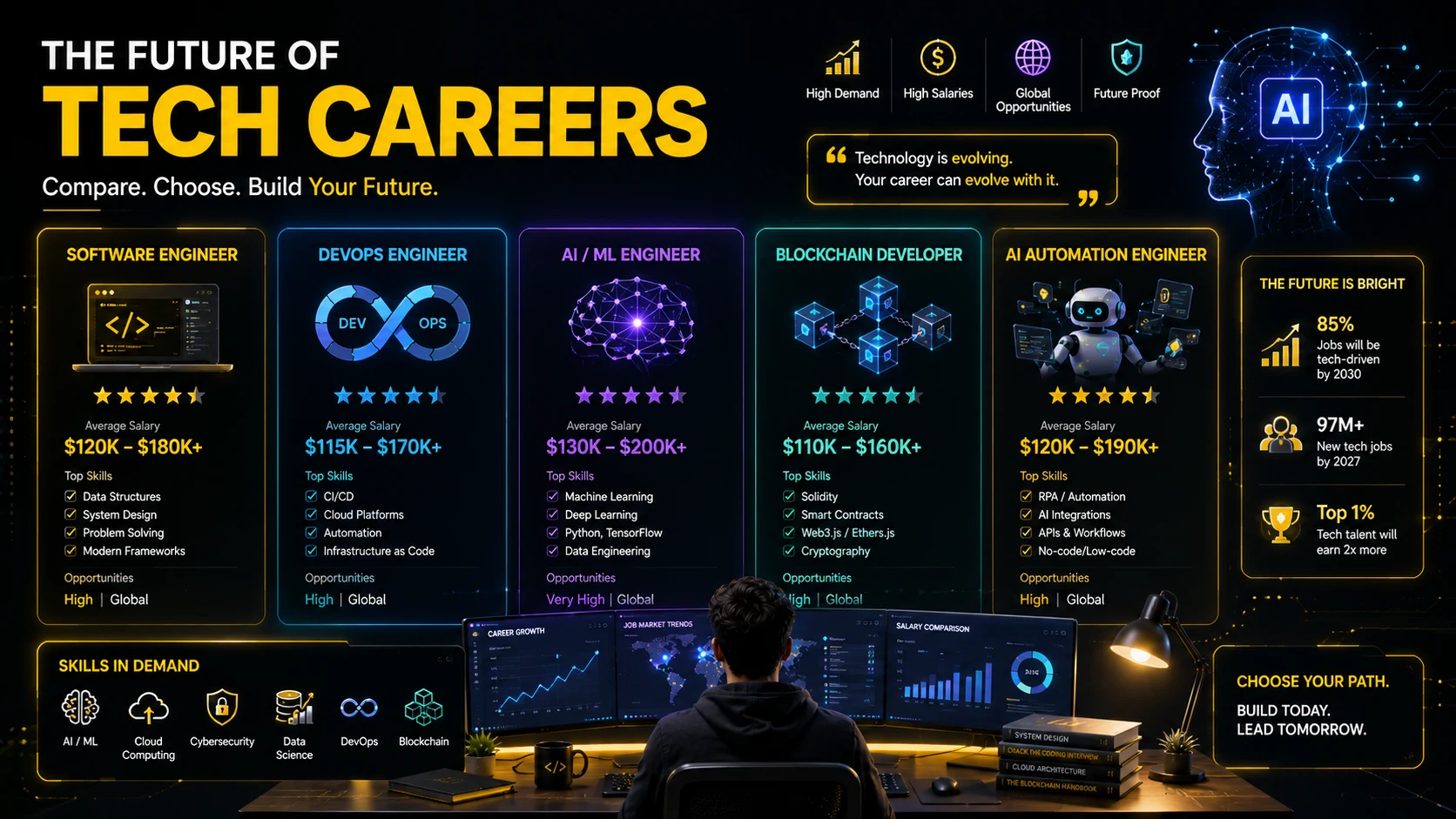
Blockchain Developers design decentralized applications (dApps), smart contracts, and secure distributed systems. Although blockchain hiring is more specialized than traditional software engineering, professionals with strong blockchain expertise remain among the highest-paid technology specialists, particularly in fintech, digital assets, and enterprise blockchain solutions.
Beyond cryptocurrencies, blockchain technology is increasingly used for digital identity, supply chain management, financial services, healthcare, and secure record management, creating new opportunities for experienced developers.
Key Skills You'll Need
- Solidity
- Ethereum
- Smart Contracts
- Cryptography Basics
- Web3 Development
- JavaScript & TypeScript
- Blockchain Security
10. AI Automation Engineer
AI Automation Engineers build intelligent workflows that combine large language models, APIs, automation platforms, and business applications to automate repetitive tasks. Instead of training AI models from scratch, they focus on integrating AI into real business processes to improve efficiency and productivity.
This role has grown rapidly with the adoption of generative AI. Organizations now seek professionals who can create AI-powered assistants, workflow automation systems, retrieval-augmented generation (RAG) pipelines, and autonomous business agents using modern AI platforms.
Key Skills You'll Need
- Python
- Prompt Engineering
- LLMs & AI APIs
- Workflow Automation
- REST APIs
- Vector Databases
- RAG & AI Agents
Recommended Certifications
| Career | Recommended Certifications | Difficulty |
|---|---|---|
| AI Engineer | Google Professional ML Engineer, Microsoft AI Engineer | Intermediate |
| Cloud Architect | AWS Solutions Architect, Azure Solutions Architect | Intermediate |
| Cybersecurity Engineer | Security+, CEH, CISSP | Intermediate–Advanced |
| Data Scientist | IBM Data Science, Google Data Analytics | Beginner–Intermediate |
| DevOps Engineer | CKA, AWS DevOps Engineer | Advanced |
Career Comparison at a Glance
| Career | Best For | Learning Curve |
|---|---|---|
| AI Engineer | AI Applications | Moderate |
| Machine Learning Engineer | Production AI | High |
| Cloud Architect | Enterprise Infrastructure | Moderate |
| Cybersecurity Engineer | Security & Compliance | Moderate |
| Data Scientist | Analytics & Business Intelligence | Moderate |
| DevOps Engineer | Automation & Cloud | High |
| Full Stack Engineer | Software Development | Moderate |
| Blockchain Developer | Web3 & FinTech | High |
| AI Automation Engineer | Enterprise AI Workflows | Moderate |
Most Valuable Tech Skills to Learn in 2026
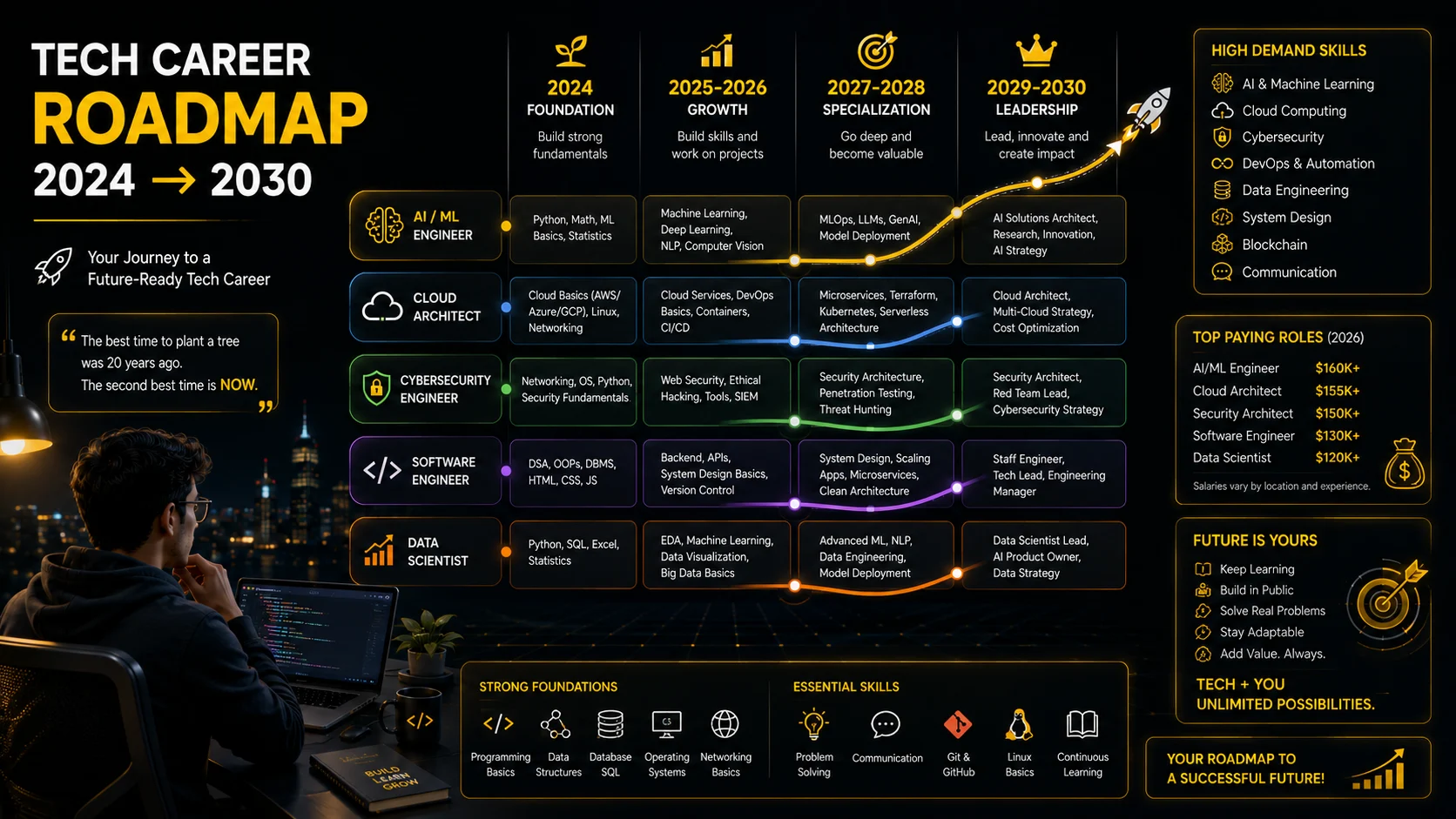
While each technology career requires a unique combination of technical expertise, several core skills consistently appear across the highest-paying roles. Developing these foundational skills not only increases your employability but also makes it easier to transition between different technology domains as the industry evolves.
Instead of chasing every new programming language or framework, focus on building strong problem-solving abilities, software engineering fundamentals, cloud knowledge, AI literacy, and practical project experience. These skills remain valuable regardless of changing technology trends.
| Skill | Why It Matters | Useful For |
|---|---|---|
| Python | Most widely used language for AI, automation, and data science. | AI, ML, Data Science |
| SQL | Essential for managing and analyzing business data. | Analytics, Backend, Data Engineering |
| Cloud Computing | Modern applications are built and deployed in the cloud. | Cloud, DevOps, AI |
| Git & GitHub | Industry-standard version control and collaboration. | All Software Roles |
| Artificial Intelligence | AI is becoming a core skill across nearly every technology job. | Almost Every Tech Career |
Common Myths About High-Paying Tech Jobs
| Myth | Reality |
|---|---|
| You need a Computer Science degree. | Strong projects and practical skills often matter more than your degree. |
| AI will replace all software developers. | AI is changing developer workflows, not eliminating the need for skilled engineers. |
| You must master every programming language. | Deep expertise in a few core technologies is usually more valuable. |
| Only big tech companies pay well. | Startups, SaaS companies, consulting firms, and enterprises also offer excellent salaries. |
The Future of Tech Careers Beyond 2026
Artificial Intelligence will continue transforming nearly every technology role over the next decade. Rather than replacing engineers, AI is expected to automate repetitive tasks while increasing demand for professionals who can design systems, solve business problems, secure applications, and supervise intelligent software.
Cloud computing, cybersecurity, AI engineering, platform engineering, and enterprise automation are expected to remain among the fastest-growing technology fields. Professionals who continuously learn and adapt will enjoy the strongest long-term career opportunities.
Which Tech Career Is Right for You?
The best career isn't necessarily the one with the highest salary it's the one that aligns with your interests, strengths, and long-term goals. Someone who enjoys mathematics and research may thrive in AI or machine learning, while individuals who enjoy building products may prefer full stack development or cloud engineering.
If you're just getting started, choose one career path, master its fundamentals, build real-world projects, earn relevant certifications, and consistently improve your portfolio. Trying to learn everything at once often slows progress.
Career AdviceFocus on becoming exceptionally good in one specialization before expanding into adjacent technologies. Employers consistently value depth of expertise over superficial knowledge of many different tools.
Conclusion
Technology continues to offer some of the most rewarding career opportunities in the world. Whether your goal is becoming an AI Engineer, Cloud Architect, Cybersecurity Engineer, Data Scientist, or Full Stack Developer, success depends far more on practical skills, continuous learning, and real-world projects than on simply following salary rankings.
Choose a career that genuinely interests you, build a strong portfolio, contribute to GitHub, earn industry-recognized certifications, and stay updated with emerging technologies. These habits will help you build a sustainable and high-paying technology career well beyond 2026.
Frequently Asked Questions
1. Which tech job has the highest salary in 2026?
AI Engineers, AI Research Engineers, and Cloud Solutions Architects are among the highest-paying technology professionals due to strong industry demand and specialized expertise.
2. Can I get a high-paying tech job without a Computer Science degree?
Yes. Many employers prioritize practical skills, certifications, GitHub portfolios, and real-world projects alongside formal education.
3. Which programming language should I learn first?
Python is one of the best choices because it is widely used in AI, machine learning, automation, backend development, and data science.
4. Are certifications enough to get hired?
Certifications improve your resume, but employers generally prefer candidates who also have strong hands-on projects and practical experience.
5. Is AI replacing software engineers?
No. AI is changing how developers work by improving productivity, but companies still require skilled professionals to design systems, review code, solve complex problems, and build reliable software.
Continue Learning with InfoShalaa
Explore more beginner-friendly career guides, programming tutorials, AI resources, cybersecurity articles, and web development content on InfoShalaa. Our goal is to help students and professionals build industry-ready skills through practical learning and real-world projects.
Final TipThe highest-paying technology careers aren't built overnight. Stay consistent, build projects, keep learning, and focus on solving real-world problems the opportunities will follow.