


The AI Edge: High-Paying Machine Learning Roles and the Hidden Skills You Need in 2026
A few years ago, a computer science degree and a GitHub profile full of "Iris dataset" notebooks were enough to turn heads. Not anymore.
In 2026, hiring managers don't really ask "do you know machine learning?" They ask "can you ship it?" That one shift has quietly rewritten what it means to build a career in AI.
Machine learning roles are still among the highest-paying jobs in tech. But the skills that actually get you hired have moved far beyond training a model in a notebook. Companies want people who can take that model from an experiment to something real users touch safely, reliably, and on a deadline.
If you're a student, a fresher, or a developer eyeing a move into AI, this guide breaks down which roles are paying well right now, which skills genuinely move the needle, and how to build a learning path that makes you job-ready, not just certificate-ready.
What Is Changing in the AI Job Market in 2026?
The AI hiring market has flipped. A couple of years ago, companies mostly wanted people who could train models and report good metrics. Today they want people who can keep AI systems running in production, day after day, without breaking.
Three forces are driving this:
- Enterprise adoption has gone mainstream. Most organizations now use AI in at least one core business function it's no longer a side-project experiment.
- The job mix has shifted from research to deployment. AI Engineer has become one of the fastest-growing job titles in tech, and demand for people who can actually deploy and operate models keeps outpacing supply.
- Specialization pays. Generalists are getting squeezed by specialists in areas like LLM fine-tuning, RAG, and MLOps and those specialists often earn noticeably more for the same years of experience.
💡 Did You Know?AI-related job postings have grown several times faster than the overall tech job market over the past two years, and professionals with verified AI skills consistently earn a meaningful wage premium over peers without them.
The takeaway: knowing the theory is the entry ticket. Knowing how to deploy, monitor, and explain your model is what actually gets you hired.
Highest-Paying Machine Learning Roles in 2026
Salaries below are approximate, indicative US-market figures compiled from multiple industry sources. Actual pay varies significantly by country, city, company size, specialization, and total compensation packages. Treat these figures as directional estimates rather than guaranteed salaries.

| Role | What They Do | Core Skills | Approx. Salary Range* | Difficulty |
|---|---|---|---|---|
| Machine Learning Engineer | Builds, trains, and optimizes models for real products. | Python, ML frameworks, data pipelines, MLOps basics | $90K–$200K (Senior $250K+, Frontier Labs $350K+) | Medium–High |
| AI Engineer | Integrates AI models and LLMs into products and workflows. | APIs, LLM integration, system design, cloud | $100K–$220K (Senior $250K–$300K+) | Medium |
| Generative AI Engineer | Builds and fine-tunes generative models for text, image, or code. | LLM fine-tuning, RAG, prompt design, evaluation | $115K–$280K (Research track higher) | High |
| MLOps Engineer | Deploys, monitors, and scales ML systems in production. | Docker, Kubernetes, CI/CD, MLflow, cloud | $90K–$165K (Senior up to $250K) | Medium–High |
| Computer Vision Engineer | Builds image and video recognition systems. | CNNs, OpenCV, deep learning frameworks | $120K–$200K+ | High |
| NLP Engineer | Builds language understanding and generation systems. | Transformers, NLP libraries, LLM tuning | $130K–$190K+ | High |
| AI Product Engineer / Manager | Bridges AI capability with product strategy. | Product sense, AI literacy, stakeholder communication | $140K–$270K | Medium |
| AI Research Engineer / Scientist | Develops new model architectures and techniques. | Advanced math, research methods, publishing | $160K–$400K+ (Frontier labs higher) | Very High |
| Data Scientist | Extracts insight and builds predictive models from data. | Statistics, SQL, Python, visualization | $90K–$180K | Medium |
| AI Solutions Architect | Designs end-to-end enterprise AI systems. | Cloud architecture, governance, stakeholder management | $140K–$230K+ | High |
*Approximate, US-indicative salary ranges. Actual compensation depends on location, experience, company size, specialization, equity, and employer.
Salary Overview by Experience Level
| Experience Level | Typical Base Salary Range* |
|---|---|
| Entry-level (0–2 Years) | $85K – $130K |
| Mid-level (3–5 Years) | $130K – $200K |
| Senior (6+ Years) | $200K – $300K+ |
| Staff / Frontier AI Labs | $300K – $500K+ (Often with significant equity) |
*Figures are approximate and primarily represent the US market. Salaries vary significantly by region and employer.
⚠️ Reality CheckMachine Learning Engineer at an early-stage startup and one fine-tuning frontier models at a major AI lab can share the exact same title and a very different paycheck. Always read the job description, not just the title.
📌 Career TipDon't chase the title. Chase the work. AI Engineer and ML Engineer responsibilities overlap heavily right now, so focus on what you'll actually build day to day rather than the label printed on the offer letter.
The Hidden Skills Companies Actually Look For
Technical knowledge gets you shortlisted, but hidden skills are what often get you hired. Most hiring managers assume candidates can build a basic machine learning model. What differentiates strong candidates is their ability to solve real business problems, communicate clearly, and deploy AI systems that actually create value.
Modern AI teams rarely work in isolation. You'll collaborate with software engineers, product managers, designers, business stakeholders, and cloud teams. That's why companies increasingly hire engineers who can think beyond notebooks and productionize AI solutions.

Hidden Skills That Make You Stand Out
| Skill | Why It Matters | How to Learn It |
|---|---|---|
| Problem Solving | Companies hire people who solve business problems, not just train models. | Practice real-world case studies and end-to-end AI projects. |
| Communication | Explaining AI decisions to non-technical teams is a critical skill. | Present projects, write blogs, and document your work clearly. |
| System Design | Modern AI systems must scale beyond a single notebook. | Learn APIs, cloud architecture, microservices, and deployment basics. |
| MLOps | Organizations need engineers who can deploy, monitor, and maintain models. | Learn Docker, Kubernetes, MLflow, CI/CD, and cloud platforms. |
| LLM & Prompt Engineering | Large Language Models are becoming part of nearly every AI product. | Build applications using OpenAI APIs, LangChain, and Retrieval-Augmented Generation (RAG). |
| Business Thinking | The best AI engineers understand customer needs, not just algorithms. | Study product thinking, KPIs, and how AI creates business value. |
| Portfolio Building | A strong GitHub portfolio often carries more weight than certificates. | Create complete projects with documentation, deployment, and demonstrations. |
💡 Pro InsightHiring managers are increasingly asking candidates to demonstrate complete AI workflows instead of solving textbook machine learning questions. Showing that you can collect data, train models, deploy them, monitor performance, and communicate business impact gives you a significant advantage over candidates who only understand algorithms.
Think of technical skills as your entry ticket. Hidden skills such as communication, deployment, collaboration, and business understanding are what accelerate career growth and help professionals move into higher-paying AI roles.
Most In-Demand AI Tools in 2026
The AI ecosystem is evolving rapidly, but a handful of tools have become industry standards. Whether you're building machine learning models, deploying production systems, or developing AI-powered applications, mastering these tools will significantly improve your career prospects.
| Tool | Where It's Used |
|---|---|
| Python | Core programming language across nearly every AI and Machine Learning workflow. |
| TensorFlow / PyTorch | Building, training, and optimizing deep learning models. |
| Scikit-learn | Classical Machine Learning algorithms, preprocessing, and rapid prototyping. |
| LangChain / LlamaIndex | Developing LLM applications, Retrieval-Augmented Generation (RAG), and AI agents. |
| Hugging Face | Hosting, sharing, and deploying pre-trained AI models. |
| Ollama | Running open-source Large Language Models locally for experimentation. |
| Docker / Kubernetes | Containerizing and scaling AI applications in production environments. |
| MLflow | Tracking experiments, managing model versions, and simplifying deployment. |
| VS Code & GitHub | Writing, reviewing, and version-controlling AI projects. |
| Azure AI / AWS SageMaker / Google Vertex AI | Cloud platforms used for enterprise-scale AI model training and deployment. |
💡 Did You Know?Vector databases like Pinecone, Chroma, and Weaviate weren't considered mainstream just a few years ago. Today, they form the backbone of modern AI search engines, enterprise chatbots, and Retrieval-Augmented Generation (RAG) applications.
Common Mistakes Beginners Make
Many aspiring AI professionals spend months learning technologies but never become job-ready because they repeat the same avoidable mistakes. Building practical experience is far more valuable than collecting certificates.
- Collecting courses instead of building skills. Completing multiple online courses doesn't replace one well-built real-world project.
- Avoiding GitHub. Recruiters frequently review GitHub profiles. A strong portfolio demonstrates consistency, coding ability, and problem-solving skills.
- Skipping deployment. A machine learning model that only runs inside a notebook isn't production-ready. Learn deployment alongside model building.
- Watching tutorials without practicing. Passive learning rarely develops debugging and engineering skills. Build projects from scratch instead.
- Ignoring communication skills. Explaining AI concepts clearly is often just as important as writing efficient code.
- Having no real portfolio. Three small, polished, and deployed projects are usually more impressive than one unfinished ambitious project.
🚫 Common MistakeMany beginners believe certificates alone are enough to secure an AI job. In reality, most hiring managers place far greater value on a well-documented GitHub portfolio with deployed projects than on a collection of course completion certificates.
Step-by-Step Learning Roadmap
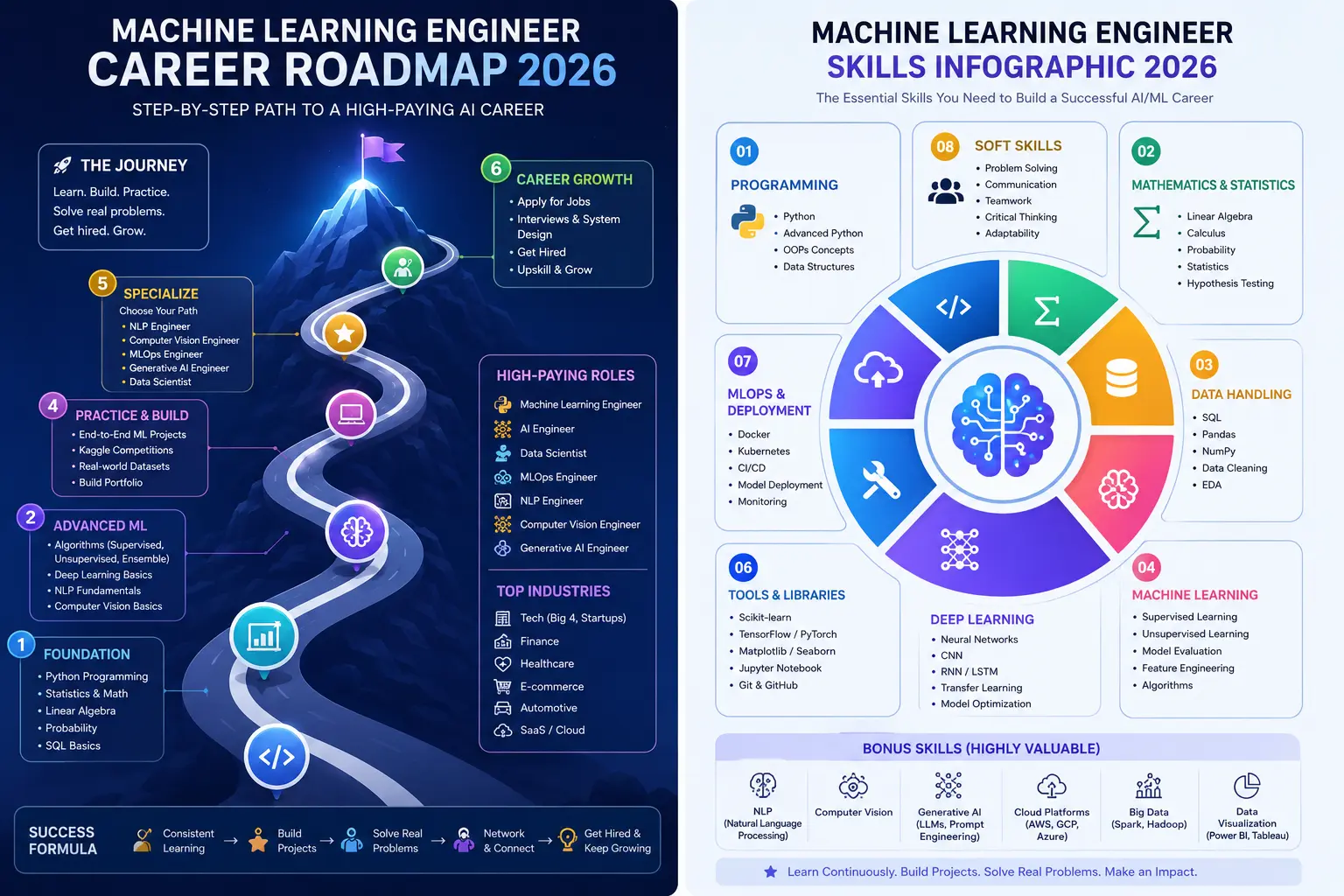
Breaking into Machine Learning doesn't require learning everything at once. A structured roadmap helps you build strong fundamentals first, specialize later, and eventually become job-ready for real AI roles.
| Phase | Focus | What to Learn | What to Avoid |
|---|---|---|---|
| Phase 1 – Foundations | Programming & Math Basics | Python, Statistics, SQL, Core Machine Learning Concepts | Jumping into Deep Learning before mastering the fundamentals. |
| Phase 2 – Core Machine Learning | Practical Model Building | Scikit-learn, Feature Engineering, Model Evaluation, Real-world Datasets | Solving only toy datasets or Kaggle problems without understanding deployment. |
| Phase 3 – Specialization | Choose One AI Domain | NLP & LLMs, Computer Vision, MLOps, or Generative AI | Trying to learn every AI specialization simultaneously. |
| Phase 4 – Production Ready | Deployment & Portfolio | Docker, APIs, Cloud Platforms, CI/CD, One Complete End-to-End AI Project | Stopping after "it works on my laptop" without deployment. |
🎯 Career AdviceDon't rush through every technology. Build a strong foundation first, create real projects, deploy them, document your work on GitHub, and continuously improve your portfolio. Employers hire people who can demonstrate practical skills not those who simply complete online courses.
Future of Machine Learning Careers
The next generation of Machine Learning careers will be shaped by rapid advances in Generative AI, autonomous AI agents, cloud-native infrastructure, and enterprise AI adoption. Rather than replacing existing roles, these technologies are expanding the demand for professionals who can design, deploy, and maintain production-ready AI systems.
Several major trends are expected to influence AI hiring over the coming years:
- AI Agents capable of planning and completing multi-step tasks with minimal human intervention.
- Generative AI moving beyond text generation into image, video, audio, software development, and enterprise automation.
- AI in Healthcare and Finance, where reliability, security, explainability, and regulatory compliance are becoming increasingly important.
- Robotics and Edge AI, allowing intelligent systems to run directly on physical devices without depending entirely on cloud infrastructure.
- AI Security, focusing on prompt injection protection, model safety, privacy, and responsible AI deployment.
Technology will continue to evolve, but one principle remains constant: professionals who consistently learn, build projects, and adapt to new tools will always remain valuable in the AI industry.